Saints
Psalm 30:4 "Sing the praises of the Lord, you his faithful people; praise his holy name.”


In the Roman Catholic Church, a saint is someone who has led an exceptionally holy and virtuous life and is believed to be in Heaven, interceding on behalf of others. Saints are recognized for their faith, devotion, and often, their sacrifices in the service of God and others.
The process by which the Church officially declares someone a saint is called canonization. This involves a thorough investigation of the person's life, virtues, and miracles attributed to their intercession after death. Once canonized, the person is venerated as a model of Christian virtue and an intercessor for believers.
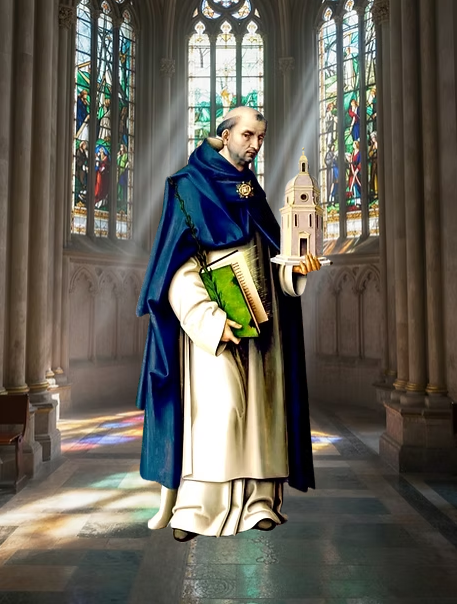
Saint Thomas Aquinas
“Grant me, O Lord my God, a mind to know You, a heart to seek You, wisdom to find You…”
Thomas Aquinas (1225–1274) was born into a noble family near Roccasecca, Italy, educated at Monte Cassino, and later joined the Dominican Order, choosing a life of preaching, study, and poverty. Thomas Aquinas’ life was defined by one goal: To understand God as deeply as possible, using every tool the human mind possesses.
He believed faith and reason are not enemies, truth is unified because God is the source of all truth, and philosophy can serve theology without replacing it. This made him the Church’s greatest synthesizer—bringing Scripture, the Fathers, Aristotle, and lived Christian experience into one coherent vision.
His masterpiece, the Summa, covered important topics such as God’s nature, creation, angels, Christology, sacraments, salvation, law and morality: Thomas writes with clarity, structure, and charity. He presents objections fairly, answers them precisely, and always returns to the central truth: God is love, and all things return to Him.
Thomas believed that the human person is body and soul as one unity. The intellect seeks truth, the will seeks the good, emotions (“passions”) are natural and morally neutral, and virtue orders the whole person toward God. Aquinas gives a framework for emotional maturity, moral decision-making, spiritual growth, psychological integration, healthy relationships His view of the person is profoundly hopeful: grace perfects nature; it does not destroy it.
Thomas’ theology of God is both philosophical and deeply devotional. His famous “Five Ways” are paths of contemplation showing that the world points beyond itself to a necessary, intelligent, loving Creator: God is Being Itself (ipsum esse subsistens); God is simple (not made of parts); God is pure act (no potential, no change); God is goodness, truth, and beauty; God is love—not sentiment, but the act of willing the good. “To love is to will the good of the other.”
Despite his brilliance, Thomas was deeply humble and prayerful. He experienced mystical visions, including one near the end of his life that made him say, "All I have written seems like straw compared to what I have seen. “This was not a rejection of his work—it was an acknowledgment that God’s reality surpasses human language. He died in 1274 on his way to the Council of Lyon and was canonized in 1323.
Saint Thomas Aquinas is the Church’s greatest theologian, a master of reason and faith, a guide for emotional and moral maturity, a mystic who encountered God deeply, and a thinker whose work still shapes Catholic doctrine, ethics, and spirituality.
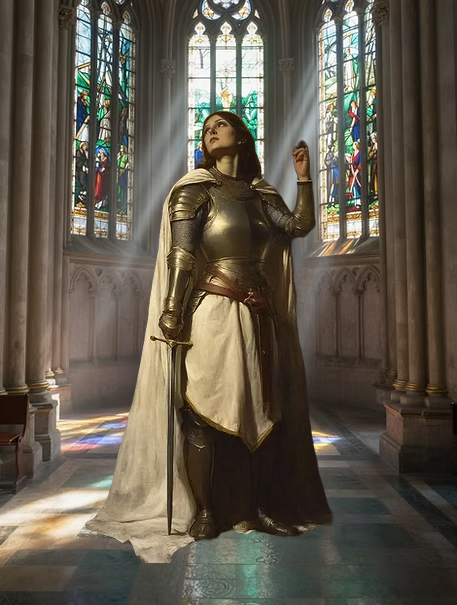
Saint Joan of Arc
“I am not afraid… I was born to do this.”
Joan of Arc (1412–1431), born in the village of Domrémy, in northeastern France, was a French peasant girl whose courage and faith changed the course of the Hundred Years’ War. She believed God called her to defend France and support the rightful king, Charles VII.
Beginning around age 12, Joan reported hearing heavenly voices from St. Michael the Archangel, St. Catherine of Alexandria, and St. Margaret of Antioch. These voices instructed her to help save France and lead Charles VII to his coronation. Later at age 16, Joan persuaded local leaders — and eventually Charles VII — that her mission was divine. She was given armor, a banner, and a role with the French army. Her major milestones were lifting the siege of Orléans (1429)—a decisive turning point; leading multiple victorious campaigns; and standing beside Charles VII at his coronation in Reims, fulfilling her prophecy. Her leadership inspired soldiers spiritually and militarily.
In 1430, Joan was captured by Burgundian forces allied with England. She was put on trial for the following: Her vision, Wearing male military clothing, Political accusations were designed to discredit her. She was condemned and burned at the stake at age 19. Twenty‑five years later, the Church declared she had been wrongly condemned. In 1920, she was canonized as Saint Joan of Arc.
Joan is the patron saint of France, a symbol of courage, purity, and holy obedience. A model for listening to God’s call, even when it seems impossible, her life shows that God often chooses the unexpected—the young, the poor, the humble—to accomplish great things.
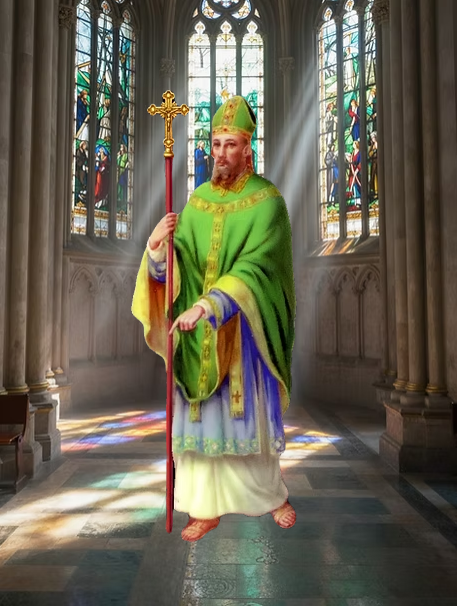
Saint Patrick
“Christ with me, Christ before me, Christ behind me.”
Saint Patrick (c. 385–461), born in Roman Britain, is the patron saint of Ireland and one of the most influential missionaries in Christian history. His life is a story of captivity, conversion, courage, and deep trust in God.
Patrick was born in Roman Britain to a Christian family, but he admitted he was not devout as a youth. At age 16, Irish raiders kidnapped him and sold him into slavery in Ireland. During six years of isolation tending sheep, Patrick underwent a profound spiritual awakening, praying constantly and developing a deep interior relationship with God.
Patrick escaped after a dream urged him to flee. Back home, he studied Christianity and eventually became a priest. Later, he experienced a powerful vision: the “Voice of the Irish” calling him to return and bring them the Gospel. He chose forgiveness over fear and returned to the land of his former captors.
Arriving around 432 AD, Patrick spent decades preaching, baptizing, and forming Christian communities. He traveled widely, founded churches and monasteries, and converted thousands. Patrick’s approach was pastoral, courageous, and culturally sensitive, helping Christianity take root in Ireland in a lasting way.
Two of his most authentic works survive: Confessio—his spiritual autobiography and Letter to Coroticus—condemning violence against Irish Christians. These writings reveal a humble, prayerful, and deeply grateful man.
Legacy. Patrick's feast day, March 17, began as a solemn liturgical celebration and later became a global cultural festival. He remains a symbol of faith, perseverance, forgiveness, and missionary courage.
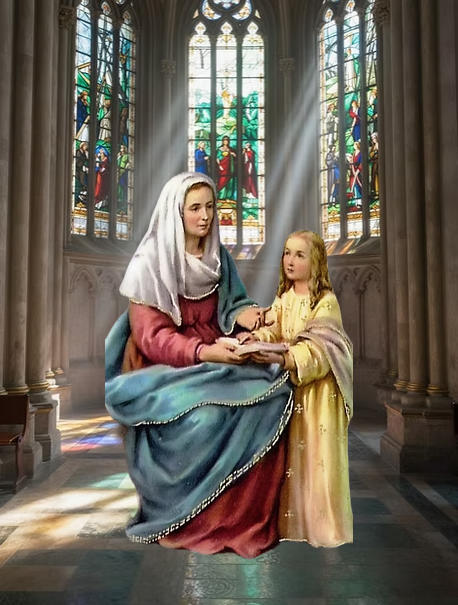
Saint Anne
Saint Anne is honored as the mother of the Blessed Virgin Mary and the grandmother of Jesus Christ. Although Scripture does not mention her by name, early Christian tradition — especially the Protoevangelium of James — preserves her story and has inspired devotion for centuries.
Anne and her husband Saint Joachim were a devout Jewish couple who longed for a child. After years of infertility, both received angelic messages announcing that God had heard their prayers. Anne conceived and gave birth to Mary, who would become the Mother of the Messiah. Because of this, Saint Anne holds a unique place in salvation history: through her motherhood, she helped form the woman chosen to bear Christ.
She is venerated as a model of faithful motherhood, patience, hope, and trust in God’s timing. Her intercession is especially sought by mothers, grandmothers, women hoping to conceive, and families seeking protection and unity.
Saint Anne’s feast day is July 26, shared with Saint Joachim. She is often depicted teaching the young Mary to read Scripture, symbolizing her role as a teacher of faith and a pillar of holy family life.
Saint Jude
“Saint Jude, worker of miracles, pray for us.”
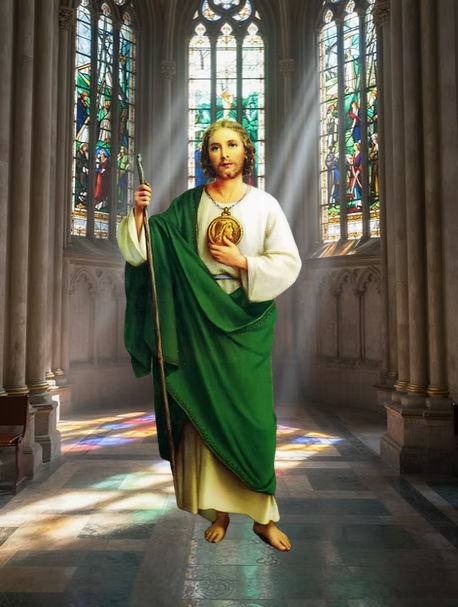
Saint Jude Thaddeus was one of the Twelve Apostles chosen by Jesus and is best known today as the patron saint of impossible causes, desperate situations, and urgent needs. He is often called Jude Thaddeus to distinguish him from Judas Iscariot.
Jude was a relative of Jesus according to early Christian tradition and traveled widely as a missionary, preaching the Gospel in Judea, Samaria, Syria, Mesopotamia, and Persia. His courage and perseverance made him a powerful witness in regions where Christianity faced hostility.
He is the author of the Epistle of Jude, a short but strong New Testament letter urging Christians to remain faithful, resist false teachings, and trust in God’s mercy. The letter ends with one of Scripture’s most beautiful doxologies, praising God’s ability to protect and sustain His people.
Saint Jude was martyred for the faith—tradition says by club or axe—and his relics are believed to rest in St. Peter’s Basilica, Rome. Over time, devotion to him grew because countless Christians testified that prayers through his intercession brought unexpected help, hope, and miracles.
His feast day is October 28, shared with Saint Simon the Zealot.
Saint Catherine of Siena
“Be who God meant you to be, and you will set the world on fire.”
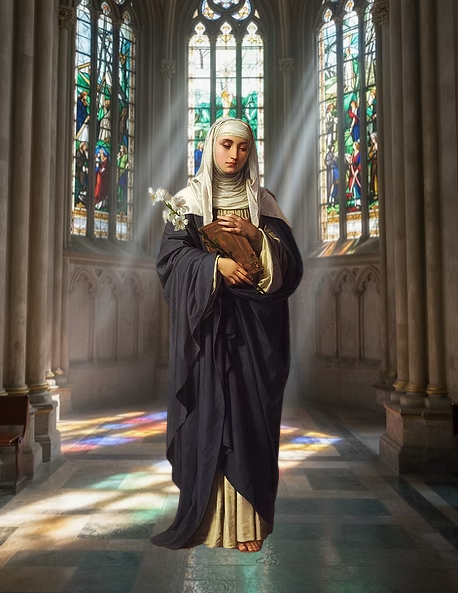
Saint Catherine of Siena (1347–1380) was born in Siena, Italy; was a Dominican laywoman, mystic, and reformer; and was one of the most influential women in Church history. From childhood she experienced profound visions of Christ and dedicated herself to prayer, fasting, and service to the poor. Though she lived quietly at first, her holiness drew people to her, and she became a spiritual guide to clergy, religious, and laypeople.
Catherine joined the Dominican Third Order, living a life of deep union with God while caring for the sick and marginalized. Her courage and spiritual authority eventually brought her into the heart of Church affairs. She wrote hundreds of letters to popes, bishops, and rulers, urging reform, peace, and fidelity to Christ. Her most famous achievement was persuading Pope Gregory XI to return the papacy from Avignon to Rome, helping restore unity to the Church.
Her major work, The Dialogue, is a powerful mystical text exploring God’s love, virtue, mercy, and the soul’s path to holiness. Catherine’s spirituality centers on truth, charity, and the transforming fire of God’s love.
She died at age 33, exhausted from her intense life of prayer and service. Catherine was declared a Doctor of the Church in 1970, one of only a few women to receive this title. Her feast day is April 29.
Saint Teresa of Ávila
“Let nothing disturb you, let nothing frighten you. All things are passing; God never changes.”
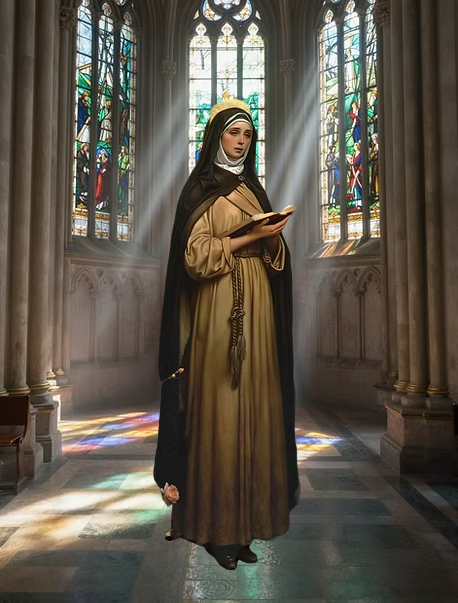
Saint Teresa of Ávila (1515–1582), born in Ávila, Spain, was a Spanish Carmelite nun, mystic, and one of the greatest spiritual teachers in Catholic history. From childhood she felt drawn to prayer, but her early religious life was divided between worldly distractions and a longing for deeper union with God. A powerful conversion experience in her thirties transformed her, leading her into a life of intense prayer, humility, and reform.
Teresa became the central figure in the Carmelite Reform, founding the Discalced Carmelites with Saint John of the Cross. She traveled across Spain establishing monasteries rooted in poverty, silence, sisterhood, and contemplative prayer. Her leadership was bold and practical, even while she lived in profound mystical union with Christ.
Her writings—especially The Interior Castle, The Way of Perfection, and her Autobiography—are masterpieces of spiritual theology. They teach the soul’s journey toward God through prayer, self‑knowledge, detachment, and love. Teresa was declared a Doctor of the Church in 1970, one of the first women to receive this title. Her feast day is October 15.